physics-samizdat

About me

a photo of me, Marvin Syed Hello! I am a theoretical physicist working on quantum many-body systems. Currently, I am a postdoctoral research associate at the University of Strathclyde in Glasgow working with Dr Peter Kirton.

Previously, I completed a PhD at the University of Cambridge under the supervision of Prof Natalia Berloff and an M.Sc. under the supervision of Prof Tilman Enss in Heidelberg.

You can contact me via email at marvin.syed(at)strath.ac.uk.

Research interests

Supersolids and pattern formation in (ultra-)cold atoms
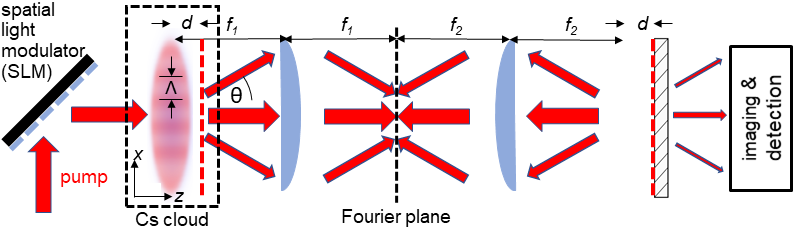
schematic of the experimental scheme for a Bose-Einstein
condensate in a single feedback mirror setup; A supersolid is an exotic state of matter that can exhibit properties of both a superfluid and a solid. For example, they display both the regular spatial structure of a crystalline solid as well as the macroscopic phase coherence of a superfluid. Supersolids can form in Bose-Einstein condensates (BECs) when long-range attractive interactions are present in addition to the usual short-range interactions between atoms in a dilute Bose gas. Such long-range interactions arise either via magnetic dipole-dipole interactions in dipolar BECs or via light-mediated interactions in laser-driven BECs. In our collaboration at the University of Strathclyde my experimental collaborators are realizing the latter via a single feedback mirror setup (see graphic above). Similar setups have long been used in the study of pattern formation in cold atomic gases, atomic vapours, liquid crystals, and other nonlinear media (see this review).

Physics-inspired optimization

Combinatorial optimization problems are frequently encountered throughout physics, computer science, biology, or finance. Many of them fall into a class called QUBO – Quadratic Unconstrained Binary Optimization. To physicists, QUBO problems are often more familiar when cast into the language of statistical mechanics and spins. Specifically, solving QUBO problems is completely equivalent to finding the ground state of a physical system called an Ising spin glass. This has prompted a line of research that aims at engineering physical systems that can efficiently emulate such Ising systems, and therefore solve QUBO problems. Examples include quantum annealers, analogue oscillator based systems called Ising machines, probabilistic bits, and more. One of my interests is trying to understand how such systems find their way towards the Ising ground state in the highly complex and nonconvex energy landscape they live in.